Newsletter Subscribe
Enter your email address below and subscribe to our newsletter

 ByJohn A
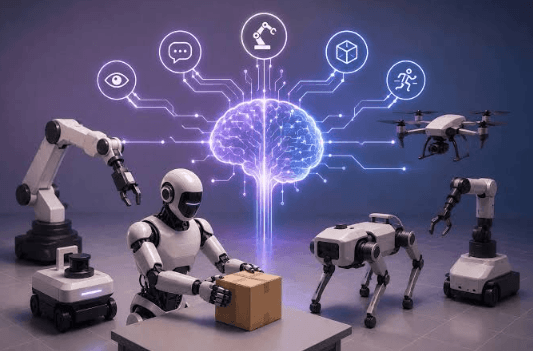
AI and robotics form a feedback-driven system where perception, planning, and control translate data into action. AI enables smarter sensing and navigation; robots provide tangible testbeds for real-time evaluation and transfer to the physical world. Effective systems require clear human–robot interaction, safety, and governance. The balance between capability and trust hinges on measurable benchmarks and robust resilience. This framework invites closer scrutiny of transferability and ethics as the field advances.
AI-driven perception and navigation in robotics rely on a tightly coupled pipeline where perception modules convert sensory data into structured representations, which are then used by planning and control systems to determine actions.
Image based localization supports accurate pose estimation, while motion planning defines feasible routes.
This framework enables adaptable autonomy, rigorous evaluation, and safe exploration within dynamic environments, balancing freedom with disciplined, verifiable methods.
Robots serve as controlled, scalable testbeds that streamline AI development and evaluation by providing consistent, repeatable environments for data collection, experimentation, and benchmarking.
This approach enables rapid iteration on autonomous hardware configurations and neural optimization strategies, reducing risk and accelerating validation cycles.
Analysts quantify transferability and resilience, identifying gaps between simulation and real-world deployment while maintaining rigorous, objective performance criteria.
In moving from demonstrated capabilities of robots as testbeds for AI development to real-world interaction, the focus shifts to how humans and autonomous systems cooperate, communicate, and establish trust.
The discourse examines human robot collaboration, delineating roles, interfaces, and feedback loops that support reliable performance.
Trust formation emerges from transparent behavior, predictable responses, and measurable alignment with shared objectives.
What ethical, safety, and practical considerations arise when autonomous systems operate in real-world contexts, and how can these factors be rigorously integrated into system design and governance?
The analysis examines ethics in autonomy, risk assessment, accountability, and governance frameworks.
It emphasizes safety by design, verifiable performance, transparent decision-making, and robust validation to ensure reliable, adaptable, and ethically aligned robotic systems in complex environments.
Regulatory frameworks govern AI-driven robotic deployment through stringent process controls and risk assessments, ensuring regulatory compliance and safety standards. They mandate transparency, validation, and ongoing monitoring, promoting rigorous, methodical governance while preserving permissible autonomy and innovative freedom.
Robots cannot possess true consciousness or genuine emotions; current capabilities reflect consciousness debate and emotion simulation. They process patterns with rigorous, analytical methods, while imagery hints at autonomy. The audience seeks freedom but must distinguish manufactured signals from sentience.
The carbon footprint of autonomous robotics varies by scale, lifecycle and energy mix, with AI driven deployment intensifying efficiency; regulatory frameworks influence adoption, while considerations of consciousness emotions and true robotics remain separate from tangible emissions, affecting job creation, worker displacement, and small businesses accessibility.
See also: le-boss-du-turf
Small businesses find accessible robotics AI through modular hardware and scalable software, but robot ethics and maintenance costs constrain adoption; careful cost-benefit analysis, vendor transparency, and ongoing support determine practical feasibility for varied freedom-oriented practices.
AI robotics will both displace some workers and create new roles; data shows displacement risks alongside opportunities in reskilling. An anecdote: a factory worker redefines tasks, illustrating how job displacement can yield new roles through systematic retraining.
The synthesis of AI and robotics emerges as a tightly coupled system, where advances in perception, planning, and control mutually reinforce real-world capability. Across domains, robots provide scalable testbeds that accelerate AI development, while smarter AI enhances autonomous sensing and navigation. A compelling statistic highlights this synergy: autonomous systems can reduce training-to-deployment cycles by up to 3–5x in field environments. Together, the disciplines advance toward transparent, safe, and trustworthy cooperative machines that perform reliably under dynamic conditions.